At present, the main body of automobile welding is resistance spot welding, laser welding, MIG and MAG welding, etc., in which laser welding technology is mainly used for body welding and body welding. Laser welding is mainly used for the welding of the body frame structure, such as the top cover and the side of the welding. Laser welding used in the car, can reduce the weight of the body to achieve fuel-saving purposes; improve the body assembly accuracy, the body stiffness increased by 30%, thereby enhancing the safety of the body; reduce the car body manufacturing process stamping and assembly costs, reduce body parts The number of body to improve the degree of integration.
1, laser welding structure
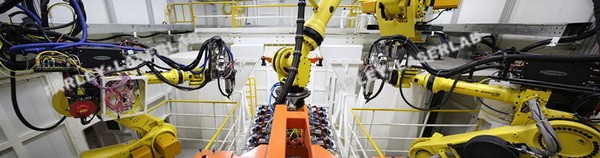
Laser welding applications using laser as a welding heat source, industrial robots as a sports system. The advantage of laser heat source is that it has a very high heating capacity, can concentrate a lot of energy in a small welding point, so with high energy density, heating concentration, welding speed and welding deformation and other characteristics, can achieve sheet Of the quick connection.
(1) laser source: laser welding for the laser source mainly CO2 gas laser source and YAG solid laser source two. The most important performance of the laser source is the output power and the beam quality. From these two considerations, CO2 laser source than YAG laser source has a greater advantage, is the main deep-melting welding laser source.
(2) light guide and focusing system: light guide system consists of circular polarizer, beam expander, mirror or fiber and focusing mirror and other components, to achieve changes in the polarization state of the beam, direction, transmission beam and focus function. The status of these optical parts has a very important impact on the quality of laser welding. In the case of high-power laser, the optical components, especially the lens performance will be degraded, the transmittance decreased, resulting in thermal lens effect, while surface contamination will increase the transmission loss.
(3) welding robot: laser welding, laser-MIG composite welding technology and the different forms of welding joints, so the assembly requirements of the welding joints are also different. Laser welding of lap welds and laser brazing of fillet welds can be made using conventional welding robots. For brazing and laser welding of butt welds, a brachial welding robot different from that of a conventional robot must be used, and a weld automatic tracking correction system is usually designed.
(4) welding fixture: laser welding can be guaranteed when the connection plate or assembly of the precise positioning to ensure that the weld gap to prevent welding deformation, thereby improving the quality of laser welding joints.
(5) laser welding control system: the control system, including the welding process of the video surveillance system, the robot's automatic tracking system and the welding system, wire control system. The composition of the control system is also the same for different laser welding methods. Laser welding without wire feeding system, weld automatic tracking system and operating trajectory correction system.
2, the advantages of laser welding
The main features of laser welding are as follows:
(1) the heat input is very small, the weld aspect ratio is large, the heat affected zone small lead to the workpiece shrinkage and deformation is very small, without welding orthopedic;
(2) high weld strength, welding speed, narrow weld and usually the surface state is good, eliminating the need to clean up after welding and so on;
(3) welding consistency, good stability is generally not filled with metal and flux, and can achieve part of the dissimilar material welding;
(4) easy to control the beam, welding positioning accurate easy to achieve automation;
(5) non-contact processing, without the need for workpiece pressure and surface treatment;
(6) small solder joints, high energy density, suitable for high-speed processing;
(7) short-term welding, both on the outside world without heat, but also on the material itself, the thermal deformation and heat affected area is small, especially for processing high melting point, high hardness, special materials;
(8) no processing noise, no pollution to the environment;
(9) can be achieved through the optical fiber, the common method is difficult to reach the site, multi-channel or time-sharing welding;
(10) it is easy to change the laser output focal length and solder joint position;
(11) is easy to carry to the automatic machine, robot device;
(12) compared with other welding methods of laser welding of the early investment is larger;
(13) is welding the workpiece assembly high precision, relatively speaking, the accuracy of the beam control also has a higher demand;
(14) Due to the splashing, the weld through the weld is brighter than the brazing, but the strength is much higher than the ordinary spot welding.
3, laser welding applications
Laser welding used in the body is divided into two main ways: one for welding, do not need to fill the material, the laser directly on the surface of the workpiece for welding; the other for the filling, that is commonly referred to as brazing, Used in the welding of the car roof.
3.1 welding
According to the laser beam energy density of the size, welding can be divided into heat conduction and penetration welding.
(1) heat conduction welding
As the laser converges at a point that produces a relatively high temperature (related to the energy density), when the temperature reaches 1490 ℃, the steel plate will melt, the use of this thermal effect of welding for the heat conduction welding, the process is: first through The laser will heat the surface of the workpiece to the melting point, the metal will melt after the formation of a hemispherical pool, pool radius and depth gradually increase, when the absorption of laser energy and molten pool to the surrounding diffusion of heat to balance, It will no longer be expanded. Moving the laser beam along the predetermined trajectory, the molten pool also moves, the metal in front of the molten pool is constantly melted, and the rear metal is cooled to form a weld. The advantages of heat conduction welding is reflected in the smooth and less splash, the speed of 1 ~ 3m / min, weld depth and width ratio of less than 1. This welding method is mostly used for plate welding.
(2) penetrating welding
In the car white car body, because the welded steel plate has 2 to 4 layers, the thickness of up to 4mm, so the depth of the weld have a higher demand, then heat conduction welding can not meet the requirements of the process, which requires another welding - penetrating welding, penetrating welding with a fast, deeper penetration characteristics, it is the laser energy density requirements are much higher than the heat conduction. When the laser acting on the surface of the workpiece, the rapid vaporization of the metal (at 2590 ℃ steel will be vaporized into steam), in the form of steam diffusion of molten pool, and the formation of a steam channel, the laser in the channel multiple reflections can make metal pairs The absorption rate of the laser energy is increased to 75%, which is referred to herein as the "small hole effect". When the generated vapor pressure is insufficient to diffuse the bath, the bath is no longer deepened to form a stable welding state. Molten pool through the location of the steam channel around the formation of metal melt flow, so that the upper and lower two layers of fusion together, the metal cooled, then the formation of a high-strength weld. Compared with heat conducting welding, the advantage of penetrating welding is that its welding depth is deeper and faster, and the welding speed is up to 5m / min for 4mm thick low carbon steel sheet. The disadvantage is that it will produce the rapid vaporization of metal A large number of splashes easily damage the workpiece and processing equipment.
3.2 Filling (Brazing)
Another way of welding is filling, which does not melt the workpiece itself, but utilizes the thermal effect of the laser to melt the wire and fill it between the two pieces of the desired weld. The advantage is that the weld is beautiful and produces The heat deformation is small, the car roof welding more use of this way. Laser roof brazing technology is the first laser processing technology used in the body, the principle of the use of laser welding wire (usually copper and silicon alloy) and filled into the top cover and side of the workpiece gap, not only play a role in the connection Can also be sealed. The process of penetration is different from that of brazing. The laser is penetrated on two layers of steel, and there is no wire filling. The robot drives the lens directly to the pre-programmed track without the need for a guide. Penetrating welding with a laser power of 4kW, much higher than brazing. Because the welding needs to melt the workpiece, so at both ends of the weld need to set the power ramp, that is, at the beginning of welding, power within 30ms from 1kW linear increase to 4kW, the end of power in 30ms from 4kW down to 1kW. The advantage of doing so is to avoid welding in the arc and arc when the plate welded to form a small hole, thus affecting the welding quality. The laser source uses YAG continuous laser generator, the maximum output up to 4kW, because the melting point of the wire relative to the steel plate is low, so the choice of laser output power range (1.8 ~ 2) kW, in the melting wire at the same time, Side does not produce thermal deformation. The laser is transmitted with flexible fiber optic cable, which separates the laser generator from the welding station to avoid damage to the equipment. According to the size of the wire diameter, in the welding end using optical lens to change the laser focus of the spot size to match each other, such as wire diameter of 1.0mm, the laser focused spot diameter adjusted to 1.2mm, the laser to maximize the role of the wire The During the welding process, the robot drives the adaptive welding lens. The rotating shaft drives the telescopic arm to rotate in the horizontal direction, and the telescopic arm itself can move in the vertical direction. The general body of the laser weld up to 42m, to ensure the overall size of the accuracy, body strength and rigidity. The use of laser brazing roof only a fine smooth weld, directly as the outer surface to increase the body of the streamline visual effects, and the use of traditional spot welding process roof there are two rubber seal.
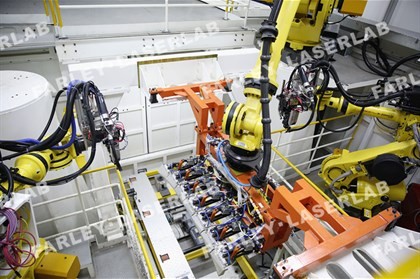
Now laser welding used in automobile body production has become a trend, the use of laser welding can not only reduce the weight of the body to improve the accuracy of the body assembly, but also greatly enhance the strength of the body, while users enjoy the comfort, to provide higher Of security. As the first set of domestic car white body laser welding complete sets of equipment, Farrell "car body cover laser welding flexible production line" to break the foreign enterprises in the field of monopoly position, to fill the domestic blank. After years of technical research, has been successfully applied to a number of integrated welding production line, welding speed of 4.8m / min, 30% faster than the world's similar types of equipment, but the price is 40% lower than the same type of foreign production line, greatly reduced Machine manufacturing costs, improve the international competitiveness of national brand cars.